
• Door naar de hoofd inhoud
  • Skip to secondary menu
  • Spring naar de eerste sidebar
  • Spring naar de voettekst
Neerlandistiek. Online tijdschrift voor taal- en letterkunde

Neerlandistiek

Online tijdschrift voor taal- en letterkundig onderzoek

  • Over Neerlandistiek
  • Contact
  • Homepage
  • Categorie
    • Neerlandistiek voor de klas
    • Vertelcultuur
    • Naamkunde
  • E-books
  • Neerlandistische weblogs
  • Archief
    • 10 jaar taalcanon
    • 100 jaar Willem Frederik Hermans
  • Jong Neerlandistiek
  • Frisistyk
  • Mondiaal

Contact between Dutch and Ainu in Tokugawa Japan

16 januari 2020 door Redactie Neerlandistiek 1 Reactie

Door Christopher Joby

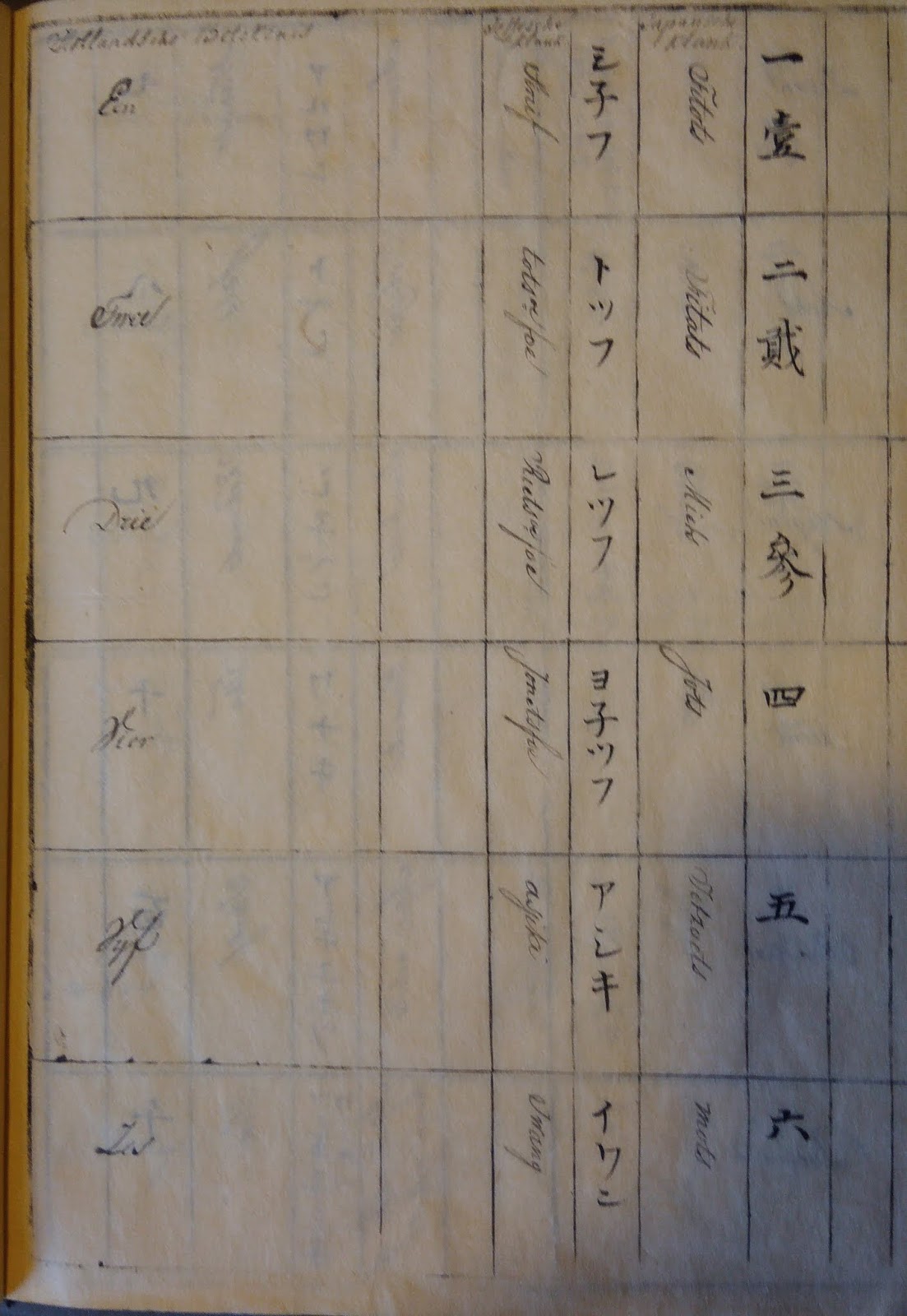
There is no evidence of the Dutch having contact with Ainu people during the Tokugawa period. The Dutch were mainly confined to Deshima, an island in the far west of the Japanese archipelago, while the Ainu lived in the north of Honshu and on Hokkaido (then called Ezo). Nevertheless, there is a  Dutch-Ainu-Japanese vocabulary consisting of 43 sheets in the Special Collections of Leiden University Library (Serrurier 95, Kerlen 1809). We do not know who compiled it or when, but there are a few clues. The introduction, written in Dutch, records that it was based on ‘an original publication by a Japanese’ (een Originele ‘uitgave’ van een Japander’). The copy in Leiden University Library has the ex libris ‘Uit de Verzam[eling] van Overmeer Fisscher’. This refers to Johannes van Overmeer Fisscher, who held various positions at Deshima. He left Japan in 1829, so this may give us a terminus ante quem for publication. 

As for the compiler, one possibility is that it was one of the Dutch interpreters sent to Ezo to make contact with Russian sailors, such as Baba Sajūrō (馬場佐十郎 (also Teiyū 貞由1787-1822)), but currently we can say nothing more concrete. For each word, from left to right, there is the Dutch term reading horizontally, then vertically the sound of the Ainu equivalent in Latin script (influenced by Dutch spelling) and katakana, followed by the Japanese equivalent in romaji and kanji. Some of the words, such as the numbers, are what one might expect to find in such a vocabulary. There is also trading terminology such as the unit of measure the gantang (Ganting in the vocabulary), but also Paap, a derogatory Dutch term for Catholics. In fact, there seems little logic to the order of the words which may be a function of the resources available. Nevertheless, it is an interesting and possibly unique example of contact between the Dutch and Ainu languages in Tokugawa Japan.

Afbeelding: Nederlands/Ainu/Japans woordenboek

Dit stukje verscheen eerder op het blog van Christopher Joby

Delen:

  • Klik om af te drukken (Opent in een nieuw venster) Print
  • Klik om dit te e-mailen naar een vriend (Opent in een nieuw venster) E-mail
  • Klik om te delen op Facebook (Opent in een nieuw venster) Facebook
  • Klik om te delen op WhatsApp (Opent in een nieuw venster) WhatsApp
  • Klik om te delen op Telegram (Opent in een nieuw venster) Telegram
  • Klik om op LinkedIn te delen (Opent in een nieuw venster) LinkedIn

Vind ik leuk:

Vind-ik-leuk Aan het laden...

Gerelateerd

Categorie: Artikel Tags: Japan, taalcontact

Lees Interacties

Reacties

  1. A.H.M. zegt

    18 januari 2020 om 19:19

    Mr. Joby, I enjoyed this post but I just realized it is not true. The Ainu were visited by Maarten Gerritsz Vries

    Beantwoorden

Laat een reactie achterReactie annuleren

Deze site gebruikt Akismet om spam te verminderen. Bekijk hoe je reactie gegevens worden verwerkt.

Primaire Sidebar

Gedicht van de dag

Gustaaf Peek • Orang-oetan

Je verlangt je gromt

Je bent een reiziger
Hoe blijf je hier tevoorschijn komen

➔ Lees meer

Bekijk alle gedichten

  • Facebook
  • YouTube

Chris van Geel

Het web houdt zijn gezicht hol in de wind,
de spin heeft het verlaten, sterren staan
er in, wind scheurt het van de aarde,
van leeggevreten gaten waait het schoon.

Bron: Maatstaf, oktober-november 1965

➔ Bekijk hier alle citaten

Agenda

10 februari 2026: Nascholingsmiddag Lezen voor waarden

10 februari 2026: Nascholingsmiddag Lezen voor waarden

13 januari 2026

➔ Lees meer
31 januari 2026: Glanzende geheimenis / Hemelse vreugde – over P.C. Boutens 

31 januari 2026: Glanzende geheimenis / Hemelse vreugde – over P.C. Boutens 

12 januari 2026

➔ Lees meer
25 januari 2026: Wel verdiend, niet ontvangen

25 januari 2026: Wel verdiend, niet ontvangen

8 januari 2026

➔ Lees meer
➔ Bekijk alle agendapunten

Neerlandici vandaag

sterfdag
1991 Jan de Zanger
➔ Neerlandicikalender

Media

Vertel het iemand van Rachida Lamrabet

Vertel het iemand van Rachida Lamrabet

13 januari 2026 Door Vlogboek Reageer

➔ Lees meer
In gesprek met auteur Jeroen Theunissen

In gesprek met auteur Jeroen Theunissen

12 januari 2026 Door Redactie Neerlandistiek Reageer

➔ Lees meer
Ik zie op tegen interviews…

Ik zie op tegen interviews…

11 januari 2026 Door Redactie Neerlandistiek Reageer

➔ Lees meer
➔ Bekijk alle video’s en podcasts

Footer

Elektronisch tijdschrift voor de Nederlandse taal en cultuur sinds 1992.

ISSN 0929-6514
Bijdragen zijn welkom op
redactie@neerlandistiek.nl
  • Homepage
  • E-books
  • Neerlandistische weblogs
  • Over Neerlandistiek
  • De archieven
  • Contact
  • Facebook
  • YouTube

Inschrijven voor de Dagpost

Controleer je inbox of spammap om je abonnement te bevestigen.

Copyright © 2026 · Magazine Pro on Genesis Framework · WordPress · Log in

  • Homepage
  • Categorie
    • Voor de klas
    • Vertelcultuur
    • Naamkunde
  • Archief
    • 10 jaar taalcanon
    • 100 jaar Willem Frederik Hermans
  • E-books
  • Neerlandistische weblogs
  • Jong Neerlandistiek
  • Frisistyk
  • Mondiaal Neerlandistiek
  • Over Neerlandistiek
  • Contact
 

Reacties laden....
 

    %d