
There are several reasons why there is absolutely no progress in the discussion about English. The language is unmistakably still on the rise in international culture: worldwide more and more people are learning the language. And as a language becomes more attractive for learners when more people speak it – the investment of learning a language gives better returns if you can speak to more people around the world, read more magazines, etc.
At the same time, a world in which everybody is forced to speak English might be the ideal world for very few people on an international scale. There is something disturbing about the fact that everybody but a small minority of the world’s population – those living in the anglophone world – have to spend many years learning the language. And when we realize that this means that many parts of the world get more and more cultured on the anglophone sphere as the only example of international culture, we may realize that something is going wrong.
All of this is happening in many places of the world, and as far as I can see it is also discussed in many media – but typically in a national scale. And in many cases, this means that the whole thing is discussed as if what is happening is typical for the language area or the language in which it is discussed: oh we, Germans, Koreans, Swedes, etc., we are the laughing stock of the world, since we are so much influenced by English. This just shows how weak our culture is. Other places do so much better than us.
A recent example in Dutch culture is this opinion piece by the Dutch author Christiaan Weijts (in Dutch: automatic translation here), lamenting the fate of Dutch literature, and observing that his own teenage children prefer to read English books. Which is a phenomenon that has been confirmed over and over again: Dutch teenagers read Young Adult literature and they vastly prefer those works coming from the anglosaxon world, often reading them in English.
Weijts claims that at least part of the explanation is that contemporary Dutch literature is so dull:
Yet I also want to venture a more painful hypothesis: is it not also a little bit up to us, the authors? If I have to name writers I discovered and embraced this millennium, I notice that I first come up with names like Sandro Veronesi, Édouard Louis, Valeria Luiselli, Zadie Smith, Michel Houellebecq, and only then with PF Thomése, Merijn de Boer , Niña Weijers, Robbert Welagen and a lot of others who are rightly angry that I forget them.
When Trouw reported on the anglicization of the book trade, it spoke to several readers who complained that in our language area books often deal with heavy themes such as the Second World War and incest. I recognize that as a reviewer for De Groene Amsterdammer: there is a lot of victim prose and public trauma processing, focused more on the true story than on a sparkling literary form, an idiosyncratic voice, on the kind of literary freedom that all the authors I mentioned above share with each other. – yes, also the Dutch ones.
The day when I read this, it happened that I was also visiting an unpretentious bookshop in a small town in Italy, and I took a picture of the table with new arrivals of the Young Adult section there. This is what it looks like:
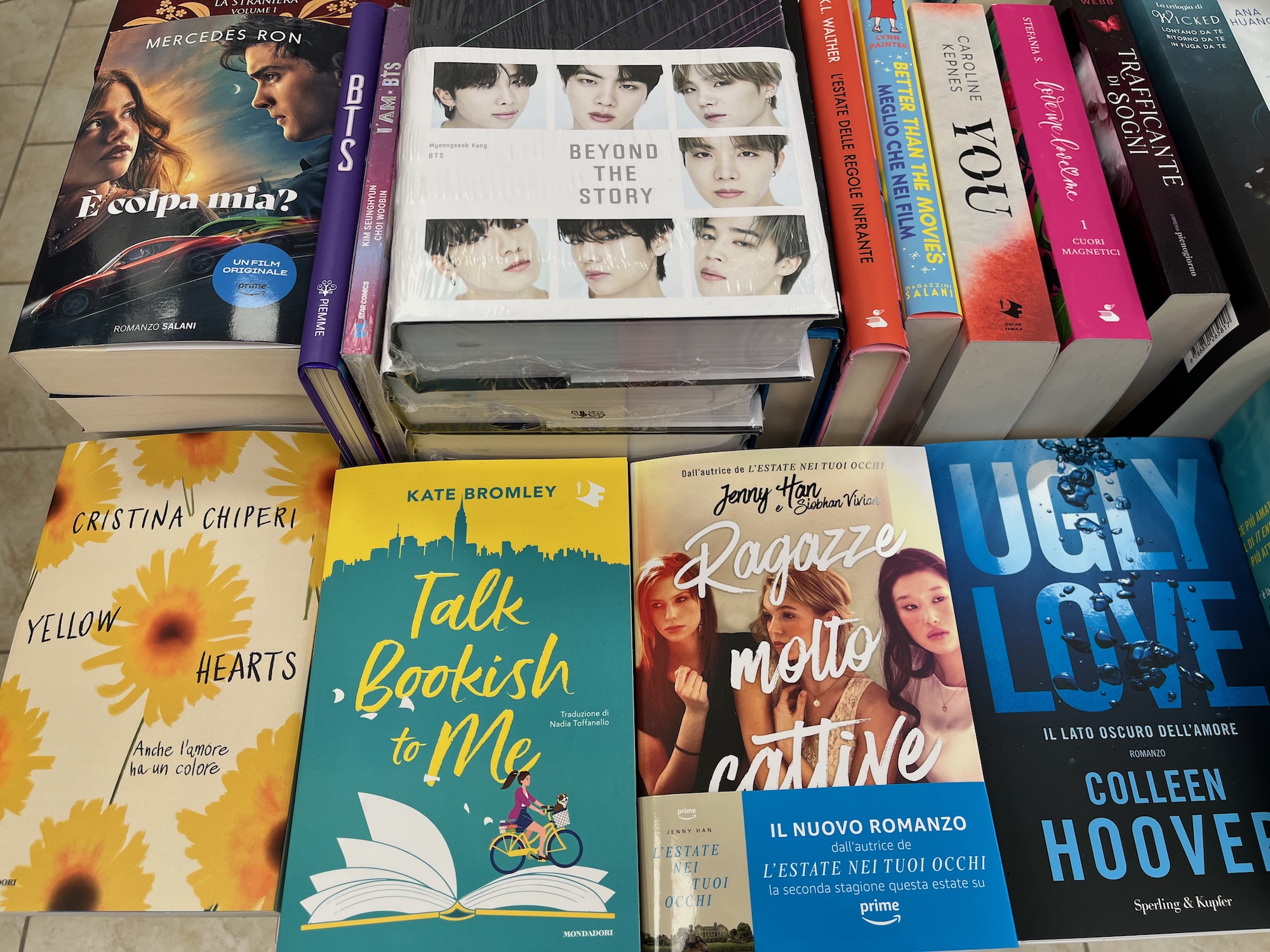
In other words: these are all books from the anglophone sphere. One difference may be that Italian youngsters still buy the translation, but those translations have a title in English. A difference may be that the average Italian young person’s English might not (yet) be at the level where they would prefer the English translation, but it is good enough to understand the title, and it seems clear that they do not read the translation because they are so proud of Italian culture, or because they think the Italian literature is experimenting with sparkling literary form. Most young Italians I have met would love to be able to read and speak English as much as their Dutch peers do.
It is an intriguing phenomenon that young people around the world are attracted to products of the anglophone cultural sphere as much as they do. It definitely also has worrisome aspects to it: it makes for a bigger world for the individual, who can discover about some great entertaining voices from a different culture, but for a smaller world after all, in which only ideas count if they come from a small set of relatively small regions in the world.
We need a discussion about this. But such a discussion should not start from the question what is wrong with us, Dutch (German, Swedish, Italian) people. It is an international phenomenon that warrants an internationally oriented analysis.
.

Laat een reactie achter