
• Door naar de hoofd inhoud
  • Skip to secondary menu
  • Spring naar de eerste sidebar
  • Spring naar de voettekst
Neerlandistiek. Online tijdschrift voor taal- en letterkunde

Neerlandistiek

Online tijdschrift voor taal- en letterkundig onderzoek

  • Over Neerlandistiek
  • Contact
  • Homepage
  • Categorie
    • Neerlandistiek voor de klas
    • Vertelcultuur
    • Naamkunde
  • E-books
  • Neerlandistische weblogs
  • Archief
    • 10 jaar taalcanon
    • 100 jaar Willem Frederik Hermans
  • Jong Neerlandistiek
  • Frisistyk
  • Mondiaal

A Dutch community in Edinburgh

1 oktober 2018 door Redactie Neerlandistiek 1 Reactie

Door Christopher Joby
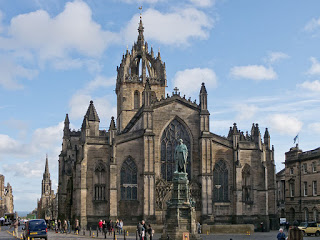
St. Giles Cathedral, or the High Kirk in Edinburgh

It is perhaps unsurprising that there was a Dutch/Flemish community in early modern Edinburgh. Lowland Scotland was primarily for the Reformation, with a church similar in theology to the Dutch Reformed church. The city lies on the other side of the North Sea from the Low Countries (well, a little to the north) and there were plenty of trading connections between Scotland and the Low Countries in the Middle Ages. The Dutch/Flemish community in Edinburgh included textile workers. Indentures were made in Dutch between local employers and weavers for the Low Countries. The Dutch artist Adrian Vanson worked at the court of James VI and his wife, Susanna de Colone, traded in Edinburgh on her own account.

In 1587 an Act of Parliament was passed to allow ‘Flemings […] to have a kirk and minister of their own’. This is suggestive of a Dutch-language church although to date I have found no firm evidence of this. In 1630, the Burgh records indicate that a Dutch schoolmaster was appointed: ‘David Phorbous, Dutche scoolemaister for teaching the Dutch language within the Burgh’. Dutch diplomats such as Hadrianus Damman, came to the Scottish court and Dutch and Flemish merchants and sailors came to Edinburgh and the nearby port of Leith. Any linguistic influence of Dutch on Scots is not easy to evaluate given their common roots -for example the Scots ‘kirk’ is cognate with the Dutch ‘kerk’ for church. One suggestion for Edinburgh is that the unpopular town guard, the Toun Rats, take their name from the Dutch ‘rot(e)’ meaning a file of soldiers. Flemish weavers introduced dolls known as ‘Flanders Babies’, a type of chest,  ’the Flanders kist’ and mirrors called ‘keeking glasses’ (kijken = ’to look’ in Dutch).

Further reading

Christopher Joby, The Dutch Language in Britain (1550-1702). Leiden: Brill, 2015, esp. Chapter 7.
Woordenboek der Nederlandsche Taal, ‘rot’.

Dit stukje verscheen eerder op The History of Dutch.

Delen:

  • Klik om af te drukken (Opent in een nieuw venster) Print
  • Klik om dit te e-mailen naar een vriend (Opent in een nieuw venster) E-mail
  • Klik om te delen op Facebook (Opent in een nieuw venster) Facebook
  • Klik om te delen op WhatsApp (Opent in een nieuw venster) WhatsApp
  • Klik om te delen op Telegram (Opent in een nieuw venster) Telegram
  • Klik om op LinkedIn te delen (Opent in een nieuw venster) LinkedIn

Vind ik leuk:

Vind-ik-leuk Aan het laden...

Gerelateerd

Categorie: Artikel Tags: taalgeschiedenis

Lees Interacties

Reacties

  1. Rob Alberts zegt

    1 oktober 2018 om 14:24

    Leuk.
    Zo blijkt maar weer dat de Noordzee toen ook al een middelpunt van Handel en volksverhuizingen was.

    Vriendelijke groet,

    Beantwoorden

Laat een reactie achter bij Rob AlbertsReactie annuleren

Deze site gebruikt Akismet om spam te verminderen. Bekijk hoe je reactie gegevens worden verwerkt.

Primaire Sidebar

Gedicht van de dag

Sint Nicolaas

Zie eens, Mietje! wat al lekkers
U, Sint Nicolaas al bragt;
Omdat ge’ als gehoorzaam Meisje,
Uw verpligting hebt volbragt.

➔ Lees meer

Bekijk alle gedichten

  • Facebook
  • YouTube

Chris van Geel

De koeien schemeren door de heg,
het paard is uit taaitaai gesneden,
in ieder duindal ligt dun sneeuw.

De branding vlecht een veren zee
waar zon over omhoog stijgt, licht waarin
geen plaats om uit te vliegen is.

Bron: Uit de hoge boom geschreven, 1967

➔ Bekijk hier alle citaten

Agenda

2 januari 2026: Vlekflits

2 januari 2026: Vlekflits

5 december 2025

➔ Lees meer
11 december 2025: Anne Frank, schrijfster

11 december 2025: Anne Frank, schrijfster

3 december 2025

➔ Lees meer
11 december 2025: Proefcollege Nederlands

11 december 2025: Proefcollege Nederlands

2 december 2025

➔ Lees meer
➔ Bekijk alle agendapunten

Neerlandici vandaag

geboortedag
1946 Dick Wortel
➔ Neerlandicikalender

Media

Dichter Esther Jansma (24 december 1958-23 januari 2025)

Dichter Esther Jansma (24 december 1958-23 januari 2025)

2 december 2025 Door Redactie Neerlandistiek Reageer

➔ Lees meer
De postkoloniale podcast met Remco Raben over Pramoedya Ananta Toer

De postkoloniale podcast met Remco Raben over Pramoedya Ananta Toer

30 november 2025 Door Redactie Neerlandistiek Reageer

➔ Lees meer
Peter van Zonneveld over Tjalie Robinson/Vincent Mahieu (1993)

Peter van Zonneveld over Tjalie Robinson/Vincent Mahieu (1993)

29 november 2025 Door Redactie Neerlandistiek Reageer

➔ Lees meer
➔ Bekijk alle video’s en podcasts

Footer

Elektronisch tijdschrift voor de Nederlandse taal en cultuur sinds 1992.

ISSN 0929-6514
Bijdragen zijn welkom op
redactie@neerlandistiek.nl
  • Homepage
  • E-books
  • Neerlandistische weblogs
  • Over Neerlandistiek
  • De archieven
  • Contact
  • Facebook
  • YouTube

Inschrijven voor de Dagpost

Controleer je inbox of spammap om je abonnement te bevestigen.

Copyright © 2025 · Magazine Pro on Genesis Framework · WordPress · Log in

  • Homepage
  • Categorie
    • Voor de klas
    • Vertelcultuur
    • Naamkunde
  • Archief
    • 10 jaar taalcanon
    • 100 jaar Willem Frederik Hermans
  • E-books
  • Neerlandistische weblogs
  • Jong Neerlandistiek
  • Frisistyk
  • Mondiaal Neerlandistiek
  • Over Neerlandistiek
  • Contact
 

Reacties laden....
 

    %d