• Door naar de hoofd inhoud
  • Skip to secondary menu
  • Spring naar de eerste sidebar
  • Spring naar de voettekst
Neerlandistiek. Online tijdschrift voor taal- en letterkunde

Neerlandistiek

Online tijdschrift voor taal- en letterkundig onderzoek

  • Over Neerlandistiek
  • Contact
  • Homepage
  • Categorie
    • Neerlandistiek voor de klas
    • Vertelcultuur
    • Naamkunde
  • E-books
  • Neerlandistische weblogs
  • Archief
    • 10 jaar taalcanon
    • 100 jaar Willem Frederik Hermans
  • Jong Neerlandistiek
  • Frisistyk
  • Mondiaal

Code switching in the Dutch East Indies

3 november 2018 door Redactie Neerlandistiek 1 Reactie

Door Christopher Joby
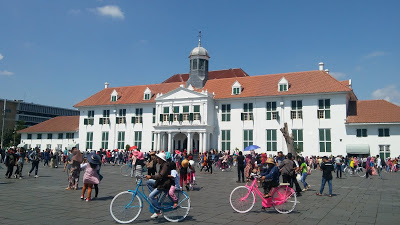
Batavia City Hall, now in the Old Town (Kota Tua) of Jakarta.

When speakers of one language encounter those of another, they often insert words of the other language into their own. This is called code switching. They may do this for a number of reasons. One of these is that they lack a word to describe a new thing or idea they encounter or because the new language has more prestige than their own. When the Dutch began trading with people in East Asia, they encountered many new things, such as goods, types of ship, coins and units of measure, to name but a few. The Dutch were prodigious record keepers, noting down almost everything that happened at their trading posts on Java, in Taiwan, on Kyushu, Japan and elsewhere in dagregisters, or factory journals. These facts mean that the Dutch language in these journals is full of code switching. A recent project on the factory journals kept at Batavia, the centre of Dutch trading activities in the East Indies, gives a sense of the number of non-Dutch words inserted into the Dutch texts.

In one or two cases, the words are of Portuguese origin, such as pancado, a fixed price for raw silk. There are also Arabic and Persian words. The Arabic coin  کبير (from the Arabic for ‘big’) and Persian gīlān ( گيلان ), a type of silk, are two examples, reminding us that the Dutch trading network spread to the Middle East. From the Indonesian archipelago we find words such as the Malay gantang, a unit of weight, and the Javanese demang, a district chief.

Several forms of Chinese are used in Dutch texts. The Mandarin huáng chuán (艎舡), a type of ship, is often given in a Malay form, wankang. Cantonese is represented with sum, a type of ginseng and Hokkein with the word for ’tea’  tê (茶), which has given rise to most European words for tea, with a couple of exceptions such as Portuguese chá (from Mandarin) and Polish herbata. Japanese coins such as the ichibu (分) are mentioned in the Dutch records and Hindi words such as kāch (काछ), a type of cloth are also used in cases of code switching.

Tough the vocabulary is very different from that being used in the Low Countries. We might call this form of Dutch used in East Asia a regiolect, or thalassolect (sea language) or perhaps emporiolect (a trading language). However, whatever we call it, what the above underlines is the diversity of the history of Dutch. In this regard, it may be better to talk, along with Peter Burke, of Dutches than one Dutch language.

Further reading

Lohanda, Mona, et al., VOC Glossary Indonesia, Published Version 1.0 on February, 6th 2018.

Dit stukje verscheen eerder op The History of Dutch

Delen:

  • Klik om af te drukken (Opent in een nieuw venster) Print
  • Klik om dit te e-mailen naar een vriend (Opent in een nieuw venster) E-mail
  • Klik om te delen op Facebook (Opent in een nieuw venster) Facebook
  • Klik om te delen op WhatsApp (Opent in een nieuw venster) WhatsApp
  • Klik om te delen op Telegram (Opent in een nieuw venster) Telegram
  • Klik om op LinkedIn te delen (Opent in een nieuw venster) LinkedIn

Vind ik leuk:

Vind-ik-leuk Aan het laden...

Gerelateerd

Categorie: Artikel Tags: Indisch Nederlands, Indonesië, taalgeschiedenis

Lees Interacties

Reacties

  1. Hans Beukers zegt

    3 november 2018 om 09:13

    Dit is een interessant artikel. Op het moment bestudeer ik de reis van Lemaire en Schouten, waarbij zij Kaap Hoorn op de kaart hebben gezet. Lemaire heeft een polynesische woordenlijst samengesteld, die op het moment tentoongesteld wordt in het koninkrijk Tonga, als oudste voorbeeld van geschreven Tongaans. Binnekort verschijnt er een artikeltje in het Kaap Hoornjournaal over Nederlandse leenwoorden in de Polynesische talen. Enkele leenwoorden zijn met hoge waarschijnlijkheid te herleiden tot Lemaire en anderen tot Tasman en Roggeveen, Nederlandse ontdekkingsreizigers. De Engelse en Franse ontdekkingsreizigers verschenen ruim een eeuw later dan de Nederlandse in de Grote Oceaan. Er zou meer studie gedaan moeten worden naar Nederlandse leenwoorden in het gebied van de Grote en de Indische Oceaan, b.v. In Japan, Korea, India en Sri Lanka, Indonesië, China, Taiwan. Van de leenwoorden in het Nederlands is al veel bekend. Ik zie al een reeks scripties voor me en een aantal proefschriften.

    Beantwoorden

Laat een reactie achter bij Hans BeukersReactie annuleren

Deze site gebruikt Akismet om spam te verminderen. Bekijk hoe je reactie gegevens worden verwerkt.

Primaire Sidebar

Gedicht van de dag

Johan van Heemskerck • Liedeke

Terwijl uw oog nog somtijds vriendelijk stond,
En ik een kus mocht krijgen van uw mond,
Was niemand zo gelukkig hier in ’t land,
Als ik mij zelve vand.

➔ Lees meer

Bekijk alle gedichten

  • Facebook
  • YouTube

Chris van Geel

Het is alsof de dingen die gebeuren
volmaakter zich aan ons voltrokken toen
wij heler onverbloemd beschikbaar waren.

Bron: Vluchtige Verhuizing, postuum verschenen, 1975

➔ Bekijk hier alle citaten

Agenda

7 maart 2026: Themadag Standaardnederlands

7 maart 2026: Themadag Standaardnederlands

1 februari 2026

➔ Lees meer
11 maart 2026: ‘Tussen oorlog en cultuur. Ede, 1600-1800’ 

11 maart 2026: ‘Tussen oorlog en cultuur. Ede, 1600-1800’ 

31 januari 2026

➔ Lees meer
13 februari 2026: Proefcollege Nederlandse Taal en Cultuur

13 februari 2026: Proefcollege Nederlandse Taal en Cultuur

28 januari 2026

➔ Lees meer
➔ Bekijk alle agendapunten

Neerlandici vandaag

sterfdag
1980 Fred Batten
➔ Neerlandicikalender

Media

Waar komen spreekwoorden vandaan?

Waar komen spreekwoorden vandaan?

1 februari 2026 Door Redactie Neerlandistiek Reageer

➔ Lees meer
Maud Vanhauwaert en Nina Geerdink over Johanna Hobius

Maud Vanhauwaert en Nina Geerdink over Johanna Hobius

31 januari 2026 Door Fleur Speet Reageer

➔ Lees meer
In gesprek met auteur Daan Heerma van Voss

In gesprek met auteur Daan Heerma van Voss

29 januari 2026 Door Redactie Neerlandistiek Reageer

➔ Lees meer
➔ Bekijk alle video’s en podcasts

Footer

Elektronisch tijdschrift voor de Nederlandse taal en cultuur sinds 1992.

ISSN 0929-6514
Bijdragen zijn welkom op
redactie@neerlandistiek.nl
  • Homepage
  • E-books
  • Neerlandistische weblogs
  • Over Neerlandistiek
  • De archieven
  • Contact
  • Facebook
  • YouTube

Inschrijven voor de Dagpost

Controleer je inbox of spammap om je abonnement te bevestigen.

Copyright © 2026 · Magazine Pro on Genesis Framework · WordPress · Log in

  • Homepage
  • Categorie
    • Voor de klas
    • Vertelcultuur
    • Naamkunde
  • Archief
    • 10 jaar taalcanon
    • 100 jaar Willem Frederik Hermans
  • E-books
  • Neerlandistische weblogs
  • Jong Neerlandistiek
  • Frisistyk
  • Mondiaal Neerlandistiek
  • Over Neerlandistiek
  • Contact
 

Reacties laden....
 

    %d