
• Door naar de hoofd inhoud
  • Skip to secondary menu
  • Spring naar de eerste sidebar
  • Spring naar de voettekst
Neerlandistiek. Online tijdschrift voor taal- en letterkunde

Neerlandistiek

Online tijdschrift voor taal- en letterkundig onderzoek

  • Over Neerlandistiek
  • Contact
  • Homepage
  • Categorie
    • Neerlandistiek voor de klas
    • Vertelcultuur
    • Naamkunde
  • E-books
  • Neerlandistische weblogs
  • Archief
    • 10 jaar taalcanon
    • 100 jaar Willem Frederik Hermans
    • Chris van Geel
  • Jong Neerlandistiek
  • Frisistyk
  • Mondiaal

“You speak old Dutch”

9 maart 2025 door Tiarra Simon Reageer

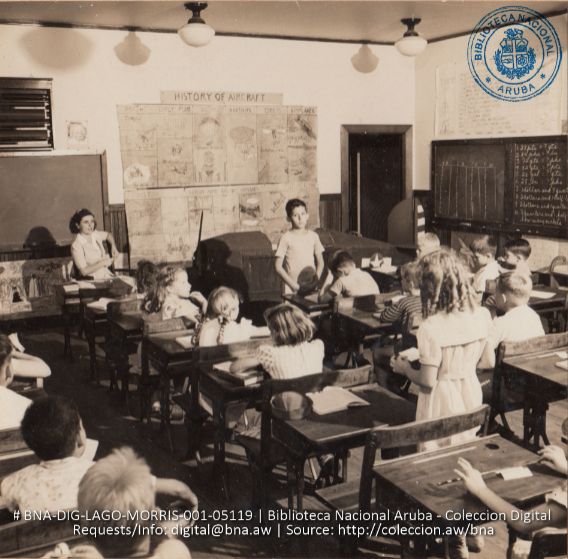
Biblioteca National Aruba. Retrieved from Archivo National Aruba (ANA)’s online archival database collection.aw

Imagine this! As a kid, you’re taught that the Dutch language is needed to survive beyond your island. You grow up thinking that this particular language is even needed to survive in the big world!

In classrooms, they discourage you from speaking your native language. So you continue conversations with your peers on the playground. Until you hear the teacher say: “Hey little ones, it’s better to speak Dutch. You can speak your language at home.” So you adhere to this: “Yes, teacher!”

After the lunch break, you rush back to your class. You notice the small hole in your desk and wonder why it’s there. Your teacher explains that, back in the day, they used to write with ink and that the hole was for ‘het inktpotje’.

Although it’s the year 2000, your schoolbooks are outdated. You struggle to comprehend the learning material. Nevertheless, your parents do whatever it takes for you to master this superior language.

When you finally migrate to the low-laying promised land, the people make fun of your accent. “Where are you from?” they ask. “Aruba” you reply proudly with a big smile. Only to learn that the majority of them have no idea where that is.

You explain to them that Aruba is part of the Dutch Caribbean islands. “Oh! Yes! Now I remember. The ABC-islands?” they ask. Kind of… you think. There are more islands, but you decide to leave that part out. Instead, you say: “It’s the same size as the Dutch island of Texel.” They laugh. “Well, that’s a small island.” You smile.

Your new teachers make fun of you as well. You speak old Dutch, just like they used to, back in the day. “We don’t say ‘baden’ anymore, we say ‘douchen’” they explain.

They advise you to attend a Dutch language school before proceeding with your education. You’ll never follow this advice, instead, you surround yourself with great Dutch-speaking people.

Slowly but surely, your native language becomes foreign to you, while code-switching becomes a reality. Finally, you feel like you’ve mastered the language!

You make writing part of your profession. You train yourself to look up the rules of the specific language because you know its depths and complexities. Yet, people still doubt your writing skills and knowledge. You feel like you’re never good enough.


This was my reality growing up on the small island of Aruba. Not all school tables were way outdated, but most of them were. And not all schools were this strict on speaking the Dutch language, but mine was.

25 years later, I read in news articles, research papers and political debates how to go about strengthening the Dutch language in some of these islands. This is a reoccuring theme, year after year. The educational system on these islands never seems to be up to standards. I can imagine why.

Dit stuk was eerder een LInkedIn-post op de pagina van Tiarra Simon

Delen:

  • Afdrukken (Opent in een nieuw venster) Print
  • E-mail een link naar een vriend (Opent in een nieuw venster) E-mail
  • Share op Facebook (Opent in een nieuw venster) Facebook
  • Delen op WhatsApp (Opent in een nieuw venster) WhatsApp
  • Delen op Telegram (Opent in een nieuw venster) Telegram
  • Delen op LinkedIn (Opent in een nieuw venster) LinkedIn

Vind ik leuk:

Vind-ik-leuk Aan het laden...

Gerelateerd

Categorie: Artikel Tags: Antillen, Antilliaans Nederlands, taalbeleid, taalkunde

Lees Interacties

Laat een reactie achterReactie annuleren

Deze site gebruikt Akismet om spam te verminderen. Bekijk hoe je reactie gegevens worden verwerkt.

Primaire Sidebar

Gedicht van de dag

Hans Faverey • Denk iets dat je goed kent

Herhaal het: zij haar haar
kamt. Doe er een spiegel
bij. Maak het vertrouwder

➔ Lees meer

Bekijk alle gedichten

  • Facebook
  • YouTube

Vlaggetjes

De arbeidersklasse danst een groote reidans
aan de oceaan der wereld

Bron: Herman Gorter

➔ Bekijk hier alle citaten

Agenda

7-8 mei 2026: Germanic Sandwich 10

7-8 mei 2026: Germanic Sandwich 10

29 april 2026

➔ Lees meer
11 mei 2026: Promotie Bartie Thijs

11 mei 2026: Promotie Bartie Thijs

28 april 2026

➔ Lees meer
8 mei 2026: Symposium Onsterfelijke dood

8 mei 2026: Symposium Onsterfelijke dood

26 april 2026

➔ Lees meer
➔ Bekijk alle agendapunten

Neerlandici vandaag

geboortedag
1940 Zdenka Hrnčířová
1964 Erik Brus
sterfdag
2013 Piet Paardekooper
➔ Neerlandicikalender

Media

Walewein: Ridder aan het hof van koning Arthur

Walewein: Ridder aan het hof van koning Arthur

1 mei 2026 Door Redactie Neerlandistiek Reageer

➔ Lees meer
In gesprek met auteur Anne Eekhout

In gesprek met auteur Anne Eekhout

1 mei 2026 Door Redactie Neerlandistiek Reageer

➔ Lees meer
Katharina de With, Christina Leonora de Neufville en Belle van Zuylen

Katharina de With, Christina Leonora de Neufville en Belle van Zuylen

30 april 2026 Door Redactie Neerlandistiek Reageer

➔ Lees meer
➔ Bekijk alle video’s en podcasts

Footer

Elektronisch tijdschrift voor de Nederlandse taal en cultuur sinds 1992.

ISSN 0929-6514
Bijdragen zijn welkom op
redactie@neerlandistiek.nl
  • Homepage
  • E-books
  • Neerlandistische weblogs
  • Over Neerlandistiek
  • De archieven
  • Gebruiksvoorwaarden
  • Privacy­verklaring
  • Contact
  • Facebook
  • YouTube

Inschrijven voor de Dagpost

Controleer je inbox of spammap om je abonnement te bevestigen.

Copyright © 2026 · Magazine Pro on Genesis Framework · WordPress · Log in

  • Homepage
  • Categorie
    • Voor de klas
    • Vertelcultuur
    • Naamkunde
  • Archief
    • 10 jaar taalcanon
    • 100 jaar Willem Frederik Hermans
  • E-books
  • Neerlandistische weblogs
  • Jong Neerlandistiek
  • Frisistyk
  • Mondiaal Neerlandistiek
  • Over Neerlandistiek
  • Contact
 

Reacties laden....
 

    %d