
Report of the workshop held on 16-17 September 2021, Ghent University
The conference workshop ‘Revisiting Revenge’ was initiated by the research groups THALIA and GEMS and organized by their members Tom Laureys, Kornee van der Haven and Jürgen Pietersin the context of a BOF-funded research project Radical Revenge? Revenge tragedy and providential thinking in the Dutch Republic 1638-1678. The workshop was furthermore related to a project about violence and the spectacular in the Netherlands between 1630 and 1690 (ITEMP). The workshop took place on the 16th and 17th of September 2021 at Ghent University’s Faculty of Arts and Philosophy. Although most speakers gave their presentation in the auditorium, considering the current pandemic participants were also able to give and follow lectures online, making it a hybrid conference.
As revenge plays traditionally have been assigned a secondary role in literary and early modern studies, this conference aimed to demonstrate the genre’s broader cultural relevance. Scholars came together to discuss how early modern European revenge plays participated in contemporary political, religious, philosophical, legal, economic and gender discourses. Questions ranged from ‘how does the genre of revenge tragedies position itself against the biblical tenet against personal revenge?’ to ‘what is the relationship between revenge and gender?’. Sixteen lectures were therefore divided into five sessions based on the speakers’ focus on gender, politics, the passions, the history of ideas or religion. Two keynote presentations by Prof. Russ Leo and Prof. Helen Watanabe-O’Kelly completed the program and brought together the different aspects of revenge tragedy.
Revenge tragedy and gender
During the first session, lecturers focused on the role of gender in revenge displayed on the scene. The function and impact of the avenging characters’ gender in the planning and the execution of revenge was further analyzed. Female and male avenging characters were compared to create a deeper understanding of the masculine and feminine gender roles in revenge tragedies and, by extension, in the early modern society.
Not only the two dominant gender identities were discussed; Karoline Baumann also noticed hybrid, ambiguous and fluent gender performances in Shakespeare’s Macbeth and Coriolanus. Among other characters, the ‘wayward sisters’ were named to illustrate this gender-bending. The complex gender expression of the avenging characters of these plays simultaneously demonstrates Shakespeare’s belief in a fixed gender role and an awareness that not all people fit those predetermined classifications.
One of the recurring topics and ideas during the lectures and discussions of this session was women’s agency and power, and its ambiguous depiction in revenge tragedies. In analyzing the effect of the rape and mutilation of Lavinia in Shakespeare’s Titus Andronicus, Mohammadreza Hassanzadeh Javanian observed a renewed authority in the silent presence of the violated Lavinia on stage. Nonetheless the dominant gaze of the male characters and the public on the victim creates a complex dynamic of power and authority in the patriarchal world on and off stage. Adam Hansen further analyzed how female characters appropriate this male power of gazing in Thomas Middleton and William Rowley’s The Changeling to create their own authority. He related the 17th century’s scientific breakthroughs in the understanding of the eye and vision to the way in which vision and vengeance are related in this play.
Merel Waeyaert closed the session with a paper about the mythological references in the speech and characterization of Juliane in Geeraardt Brandt’s De veinzende Torquatus. Just as in the earlier presentation of Mohammadreza Hassanzadeh Javanian, the literary trope of a vengeance over a rape victim was the topic of Merel Waeyaerts lecture. During the play, Juliane is associated with the mythological figures of Lucretia, Media, the Furies and Nemesis creating a threefold evolution in her characterization which creates new meaning to her vengeance.
Revenge tragedy and politics
The second session examined the way in which revenge tragedies the interaction between revenge tragedies and the contemporary. Central questions were ‘in what way does revenge tragedies reflect on national traumas?’ and ‘how does the genre adopt a position in the political debates such as the one about sovereignty of the national leader?’. The discrepancy between not only private and public, but also irrational and rational revenge were already introduced during the first session but got further investigation within the following two lectures by Marco Prandoni and Isabel von Holt.
Both scholars discussed revenge in genres that were not traditionally considered to be revenge plays: Dutch historical plays and German Baroque Trauerspiel or mourning plays. Marco focused on the Floris V-plays and Vondel’s Gysbrecht van Aemstel, while Isabel talked about the first and second version of Gryphius’s Carolus Stuardus and Von Lohenstein’s Agrippina. In his presentation, Marco revealed the different conceptualizations and functions of revenge, vengeance, and divine providence in four plays about the conspiracy against and death of count Floris V. Isabel illustrated the ambiguity in the self-description of the allegorical personification of Revenge. Revenge is seen as both a rational, righteous, even divine, punishment, and as an irrational, vicious desire or thirst for violence.
Revenge tragedy and the passions
The following lectures by Vanessa Lim and Kornee van der Haven investigated the relation between revenge and the passions. This session questioned how internal thoughts, desires and passions relate to revenge and how they help shape the revenge portrayed in the tragedies. Furthermore, relations between internal contemplations on and external acts of revenge, and between rational thought and irrational desire, were examined.
Vanessa Lim discussed the rhetorical strategies of deliberation in Shakespeare’s Hamlet to demonstrate its central role in deciding on revenge.Hamlet’s doubt and contemplation both demonstrate how he verbally attempts to turn himself into an avenger and encourage the spectators to ask themselves the same questions about retribution. The play gives early modern public and modern scholars an example of the Renaissance’s ideal of rhetorical deliberation.
These internal thoughts and desires were further analyzed in Kornee van der Havens paper about revenge in the neoclassical poetics and practice. By analyzing the tragedies of Claas Bruin, he demonstrated how the neoclassical decorum does not result in a complete lack of revenge on scene, but in an internalization of the revenge and a concentration on the underlying passions and desires.
Revenge tragedy and the history of ideas
During the fourth session David Manning, Yağmur Tatar, Caitlín Rankin-McCabe and Anne-Valérie Dulac discussed revenge in its relation to the history of ideas. Early modern revenge tragedy was used as a tool to reconstruct contemporary intellectual thought and imagery, such as fashion and afterlife. The central question of this session could be summarized as ‘how was revenge given shape in philosophical and religious thought and discourse, and how did literature and theatre reflect or divert from these conceptions?’.
In his presentation about Behn’s Abdelazar, or The Moor’s Revenge, historian David Manning emphasised the importance of historical contextualization of early modern texts. He approached the play from a historian’s standpoint to reconstruct the tragedy’s meaning of the past, opposing modern literary interpretations and what he considered as anachronistic classifications of the play as a ‘slave narrative’. By doing this, he sparked a discussion about the importance of modern interpretation and historical contextualization in literary studies.
Yağmur Tatar used Bakhtin’s definition of the carnivalesque to describe revenge in Shakespeare’s Coriolanus. She examined how the carnivalesque and saturnalian imagery, such as food, disease, and animals, are related to the revenge of the plebeians on Coriolanus, and, conversely, of Coriolanus on the people of Rome. By examining this carnivalesque in not only Shakespeare’s, but also his contemporaries’, works, we could obtain a better understanding of the carnivalesque in the Renaissance.
Caitlín Rankin-McCabe analysed the ambiguous nature of figures that stand between life and death in four different plays: ghosts and spirits in Shakespeare’s Hamlet and Julius Caesar, the character Revenge in Thomas Kyd’s The Spanish Tragedy, and Andrugio in John Marston’s Antonio’s Revenge. The protagonists’ doubt about their either holy or infernal nature makes the public question their belief in and image of the supernatural and afterlife.
The session about the history of ideas was closed with a paper by Anne-Valérie Dulac about fabrics, textiles, and fashions in Webster’s Jacobean revenge tragedy The Duchess of Malfi. The characters’ costumes and verbal references to their clothes could tell us something more about the Jacobean concern with changing fashions.
Revenge tragedy and religion
The last four lectures of the workshop revolved around revenge and religion. Scholars explored early modern revenge tragedies’ reflection on and response to Christian discourse and debate on revenge. The reflections on and representations of divine providence and the biblical message of divine retribution were sought in early modern revenge tragedy.
Tragedies related to the different branches of Christianity were furthermore compared to create a better understanding of the conceptualizations and moral connotations of revenge. Aiming for such an understanding of the variation of Christian revenge, Anne G. Graham compared a French protestant and Catholic biblical play: Robert Garnier’s Les Juifves and Théodore de Bèze’s Abraham sacrifiant. The plays illustrate trust in the divine providence, but also demonstrate God’s capacity of violence while taking vengeance.
The relation between justice and revenge in a Christian setting was discussed by Sarah Fengler during her presentation about Racine’s Christian school play Athalie. By analyzing the different narratives of revenge in the play and examining the religious and political justifications for revenge made by the character Joad, she showed how conflicting Christian morals and ideas on revenge are represented in revenge tragedies.
The Christian morals were furthermore discussed by Dinah Wouters. In her study of Joseph plays she noticed a sudden presence of revenge in the Jesuit school plays after 1600. While Joseph plays mostly focus on justice and forgiveness, in Latin school plays revenge is interwoven in both the main and sub-plot: Joseph considers revenge instead of immediately choosing forgiveness.
Tom Laureys’s chosen subject for his closing lecture was the representation of seventeenth-century theological discussions and debates in revenge. He discussed how excessive violence on stage confronts the theatre audiences with the discussions surrounding the existence of evil and God’s responsibility for this evil.
Revenge tragedy in all its aspects
The keynote lectures by Russ Leo and Helen Watanabe-O’Kelly brought together the different themes and topics surrounding revenge tragedy discussed by the other scholars. Russ Leo’s discussion of Oudaen’s Servetus, a play about an executed heretic, did not only tap into religious discourses of collegian and anti-trinitarian movements, but was also closely related to contemporary political issues. As a reproduction of historical events, the analyzed play feels like a documental drama.
Helen Watanabe-O’Kelly noticed the variation in the Christian concept of revenge by observing and comparing three protestant and one catholic revenge play. Her lecture revealed different concepts and motivations of revenge, depending on the branch of Christianity, but also drew a comparison between private and public revenge. With one of the dramas written and performed for the baptism of the son of Ferdinand of Bavaria and Henriette of Savoy, the play’s additional relation to politics is clear.
Both keynote speakers paid close attention to performativity, theatricality, and the practical side of staging revenge tragedies. Russ Leo shed light on the risk, the effect and reaction of unbelievable and unrealistic spectacle in the Senecan plays. Helen Watanabe-O’Kelly furthermore discussed costumery, staging and decor to illustrate the spectacularism of the plays. She, moreover, related the theatre to early modern visual sources of emblem books and iconology.
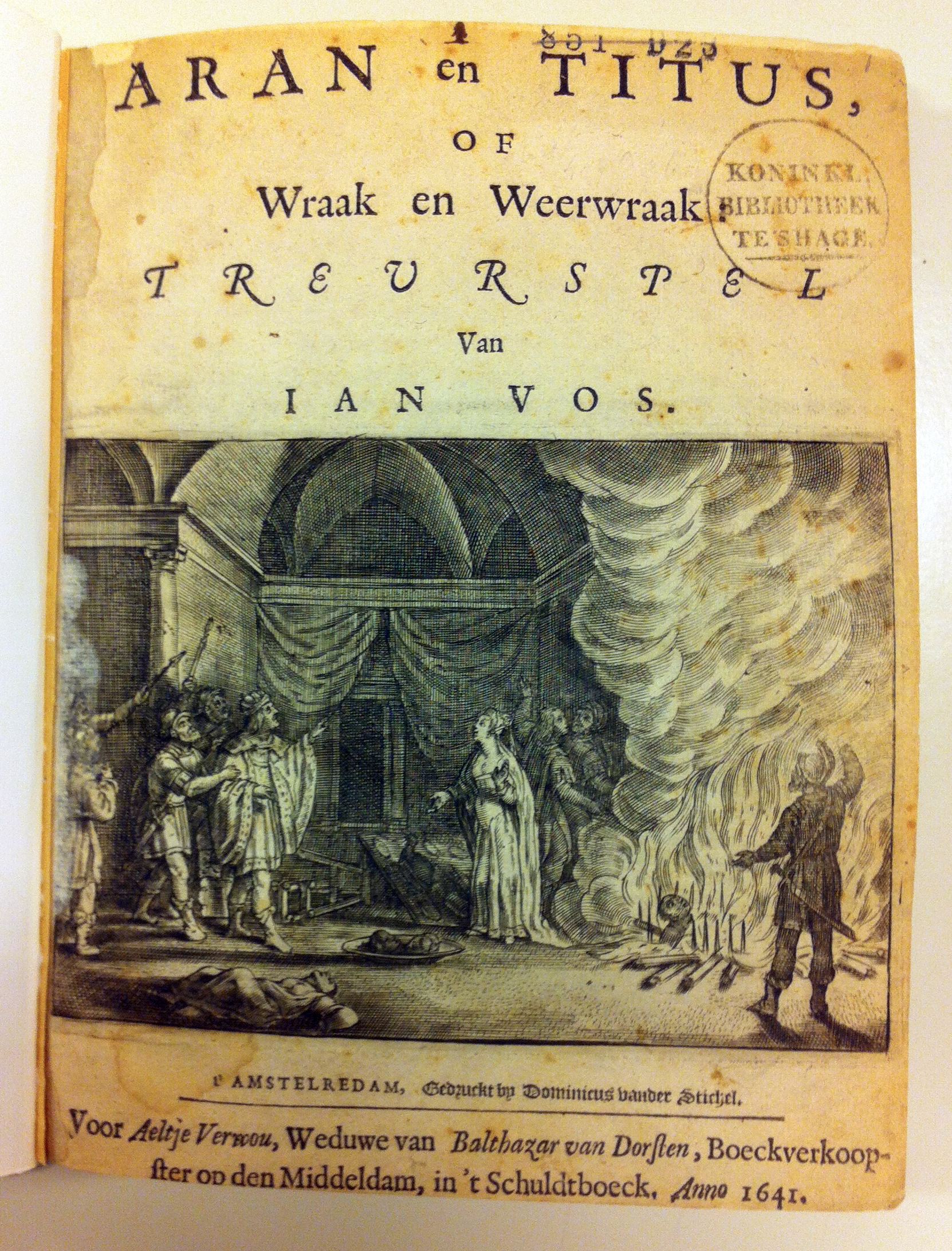
Although presentations were divided into five sessions, topics and discussions overstepped the boundaries of the different thematic groups: literary tropes like vengeance for a chaste rape victim, allusions to the nation and sovereignty, mythological references, the ambiguity of revenge and the oppositions between private and public, irrational and rational, human and divine, unjust and just revenge, were interwoven in all the sessions and discussions. During the question rounds scholars were furthermore challenged to approach their primary texts with other frameworks related to the other sessions.
The choice to discuss early modern revenge tragedy from a pan-European perspective led to a broad variation in approaches, topics, and texts. Firstly, a historian’s perspective on and approach to literature complemented the literary scholars’ presentations. Furthermore, national differences in the literary conventions surrounding revenge tragedy were noticed and the causes for the dissimilarities were sought; for example, the harshness of the German theatre in comparison to the English or Dutch tradition may be related to their educational and moral function or lack thereof. Moreover, not only plays traditionally conceived as revenge tragedies were topics of discussion, but different genres and theatrical aspects were presented. Lastly, during most presentations there was attention for visual and material sources, such as the image of Revenge as a personification and the costumery.

Veel dank voor dit uitgebreide verslag!