
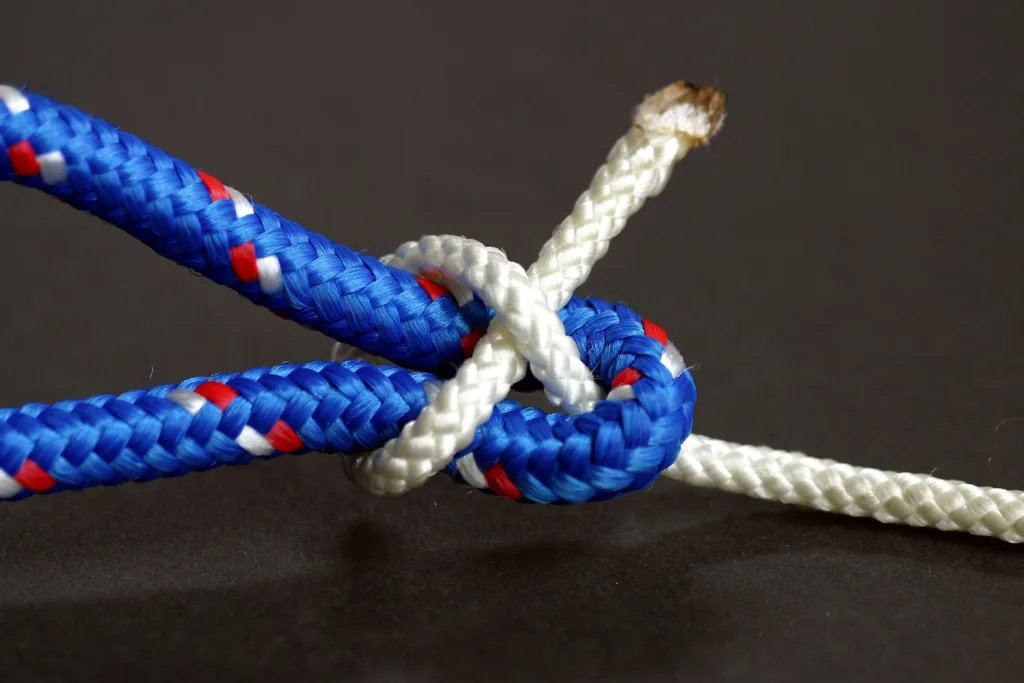
Nylon is een begrip uit de scheikunde. Het woord werd naar alle waarschijnlijkheid ook bedacht door een scheikundige. Het is een taaie, elastische en synthetische vezelstof, gebruikt in textiel en kunststoffen en bestand tegen o.a. hoge temperaturen. Men gebruikt de term ook voor een kous van deze stof.
We hebben hier te maken met een soortnaam die door de firma Du Pont in 1938 in de VS werd geïntroduceerd. De oorspronkelijke benaming zou no-run (laddervrij) geweest zijn maar dat waren de kousen helemaal niet. Daarom werd er gevarieerd op die naam, waarbij men via nuron, nulon en nilon op nylon kwam. Er doen nog andere veronderstellingen de ronde. Het acroniem zou staan voor New York-London (die verklaring staat o.a. in Odhams Dictionary of the English Language uit 1946) of Now you lousy, Old Nippon (nou jij, smerige ouwe Jap).
Toen na de oorlog dit verhaaltje naar Europa kwam, ging het er bij de toenmalige anti-Japanse bevolking in als gesneden koek.
Mooi meisje
Maar dergelijke veronderstellingen kunnen naar het rijk der fabelen verwezen worden. Het gaat wel degelijk om een bedacht woord, wellicht afkomstig van de scheikundige Wallace Hume Carothers (1896-1937), die destijds in dienst was van de firma Du Pont. De firma zou volgens sommige bronnen in 1939 een prijsvraag onder het personeel uitgeschreven hebben. Er moest toen een naam bedacht worden voor de nieuwe stof. En nylon kreeg de prijs.
Maar dat jaartal klopt niet met de eerste vindplaats. In De Telegraaf van 30/11/1938 lezen we:
De E. J. Dupont de Nemours heeft een zijde-substituut ontdekt, welke aan de markt zal worden gebracht onder den naam Nylon. De vice-president der maatschappij zeide bij de introductie van het nieuwe product, dat Nylon sterk is als staal, even fijn als spinrag en niettemin elastischer dan welk gewoon natuurlijk weefsel ook, terwijl het product een prachtigen glans bezit.
Volgens Onze Taal (januari 1959) wordt het woord in het Nieuwgrieks nailon gespeld en heeft het de betekenis van ‘mooi meisje’ gekregen.
Depressie
Nederland ontleende het woord rechtstreeks aan het Amerikaans-Engels, terwijl Vlaanderen dit deed via het Frans (uitspraak: nielón).
In de jaren tachtig van de vorige eeuw circuleerde een tijdje het ‘scheldwoord’ nylonkijker. Daarmee werd bedoeld: iemand die opzichtig vrouwenbenen bestudeert.
Wallace Hume Carothers, de chemicus die aan de wieg stond van de kunststof (en mogelijk ook het woord) nylon, huwde met een werkneemster van de firma Du Pont. Hij pleegde echter zelfmoord (met een dosis cyaankali) vóór de geboorte van zijn kind. Mogelijk leed hij aan bipolaire stoornis en de dood van zijn zuster in 1937 zou hem in een diepe depressie geduwd hebben.

Ik heb ooit ergens gelezen dat de naam bedacht is door een werknemer van de firma (Wallace Hume Carothers?), tijdens een vlucht tussen New York en Londen. De naam zou een verder niets betekenende samenstelling zijn van de afkortingen NY en LON op het vliegticket of het bagagelabel van de betrokkene. Misschien is dit evengoed een broodje-aapverhaal, hoor.
Hoe bedacht het woord Nylon ook mag zijn, deze polymeer is een klassiek voorbeeld van serendipiteit: een aanvankelijk ongezochte vondst. Dit vond ik erover in mijn serendipiteitsarchief. Voor U gekopieerd, om te laten zien, dat, ook in de (polymeer)chemie “La réalité dépasse la fiction”:
(Maar eerst even deze ‘ad hoc’ terzijde. Dr. J. Rutting (†), chemicus schreef mij in 1980 een brief, waaruit ik het volgende citeer: “Men is bezig met een onderzoek en daarbij merkt men verschijnselen op die op zichzelf niets te maken hebben met de gang van het onderzoek. Slordige onderzoekers zullen deze voorbijgaan met de gedachte dat het onbelangrijke toevalligheden zijn die toe te schrijven zijn aan onnauwkeurigheden bij het werk (bijv. onzuiverheid van stofeen waarmee men werkt). Nauwkeurige en ijverige onderzoekers gaan (als ze er de tijd voor hebben) deze bijverschijnselen niet uit de weg, maar betrekken ze in het onderzoek. Op deze manier kan men tot ontdekkingen komen die belangrijker zijn dat het eigenlijke onderzoek waarmee men bezig is. Het zijn de ‘bloempjes langs de weg’, die een fraaiere ruiker vormer dan die men zoekt en die men dus niet langs de weg moet laten staan.”)
[Begin kopie]
Nylon
Something occurred in 1930 during an experiment with a polyester made from ethylene glycol and sebacic acid which was destined to be of very great practical value. In an attempt to remove a sample of the heated polymer from the vessel in which it was prepared, Dr. Julian W. Hill, working under the direction of Carothers, noted that the molten polymer could be drawn out in the form of a long fibre. More important, he found that even after the fibre was cold it could be further drawn to several times its original length, and that such cold drawing greatly increased the fibre’s strenght and elasticity. This phenomenon had never before been observed with a compound of this type.
Nylon was the first of the truly synthetic fibres. Its inventor, Wallace H. Carothers, by his work on the synthesis and structure of high molecular weight polymers, added greatly to scientific knowledge and, through the elucidation of the theory of fibre structure, paved the way to the discovery of other commercially useful synthetic fibres.
The story of the discovery begins in 1927 when E.I. du Pont de Nemours & Company decided to support a programm of fundamental research. Dr. Charles M.A. Stine, head of du Pont’s Chemical Department at the time, having persuaded the Executive Committee to set aside a yearly fund of about $ 250,000 for the purpose, sought for outstanding research chemists. Dr. Wallace H. Carothers, a brilliant young chemist, then 32 years of age, who taught at the University of Illinois and at Harvard, was offered the direction of the group and he joined the firm in Februari 1928.
While at Harvard, Carothers had already given thought to polymerisation and the structure of substances of high molecular weight, and for du Pont he chose to study the structure and synthesis of long-chain molecules. His early work at du Pont revolved around the classic reaction between an organic acid and an alcohol, to form an ester. In this way it was possible to synthesise polyesters in which the acid and alcohol molecules are joined end to end somewhat like a chain of paperclips.
At first this information was only of academic value, since Carothers and his associates were primarily interested in the phenomenon of polymerisation. But something occurred in 1930 during an expriment with a polyester made from ethylene glycol and sebacic acid which was destined to be of very great practical value. In an attempt to remove a sample of the heated polymer from the vessel in which it was prepared, Dr. Julian W. Hill, working under the direction of Carothers, noted that the molten polymer could be drawn out in the form of a long fibre. More important, he found that even after the fibre was cold it could be further drawn to several times its original length, and that such cold drawing greatly increased the fibre’s strenght and elasticity. This phenomenon had never before been observed with a compound of this type.
While fibres of this original superpolymer were not of practical use because they were easily softened by hot water, they nevertheless suggested that some related compound might produce fibres that would possess the characteristics desired for use in textiles. Further investigation was accordingly undertaken in an effort to create a material from which strong, elastic, and water-resistant fibres could be drawn and spun. Numerous new superpolymers were synthesised, but each was deficient in respect of one or more textile properties. Carothers actually gave up the project for several months in 1930 and eventually abandoned his study of the polyesters, reaching the conclusion that they had no commercial possibilities; the outlook at one time was so uncertain that du Pont seriously considered dropping the whole of the work.
It was at this time that Dr. E.K. Bolton, who had succeeded Dr. Stine as Director of the Chemical Department, urged Carothers to review his findings in an efford to discover some basis for a superpolymer from which commercially useful fibres might be prepared. Carothers then turned his attention to the polyamides, made in somewhat the same way as the polyesters except that a bifunctional amine (nitrogen-containing compound) is used instead of a bi-functional alcohol. He found that several polyamides, when extruded through a spinneret improvised from a hypodermic needle, produced filaments from which fibres of the type now known as Nylon could be made. These new polyamides appeared so promising that extraordinary effords were made to bring the development to commercial success.
After further experiments, Carothers and his associates developed a polyamide which they called ‘66’ polymer, from which strong, tough, elastic, water-resistant fibre could be spun, capable of withstanding temperatures in excess of 500 degrees F. As in the case of the polyesters, it was found that fibre spun from ‘66’ polymer and related polyamide had to be cold drawn to some three or four times the original length in order to develop the desired strength and elasticity. During this stretching or cold-drawing operation, a highly interesting phenomenon takes place: the long, chain-like molecules which make up the undrawn fibre are arranged in an helter-skelter fashion but, on cold-drawing to several times its original length, they take on an orderly arrangement. They become parallel to the fibre axis and to one another, as in silk, and are also brought much closer together. Increased molecular proximity results in increased inter-molecular atraction, which in turn gives rise to greatly increased strength and elasticity.
Textile experts at du Pont selected ‘66’ polymer, made by the reaction between hexamethylene diamide and adipic acid, for commercial development and, although several hundred different polyamides have been synthesised and evaluated in the course of du Pont’s work on Nylon, ‘66’ is still the type most widely used for textile purposes. (The Sources of Invention, J. Jewkes, D. Sawers, R. Stillerman, Macmillan, London, 2 ed. ed, 1969, p. 275-7)
In the 1930s a Du Pont de Nemours chemist named Wallace Hume Carothers was investigating molecules containing amine and carboxyl groups in the hope that he could make them form molecules with large rings, important in the perfume industry. Accidentally he discovered that they condensed into long-chain molecules.
This was another case of the serendipity that has attended scientific discoveries, and Carothers quickly followed it up. After hundreds of exepriments he and his team succeeded in producing fibers from adipic acid and hexamethylene diamine. These fibers were at first too weak because water formed in condensation prevented polymerization from going far enough. Carothers found a cure for this by carrying the water away in a kind of ‘still,’ after which polymerization could continue indefinitely, producing fine long straight chains.
When the polymer was melted and extruded through tiny holes, it produced a silklike thread that could be woven into a textile as beautiful as silk, but stronger. It was named ‘nylon,’ but Carothers did not live to see its phenominal development; he died in 1937. The following year Du Pont announced the birth of nylon and began producing the ‘new silk made on chemical base’ commercially in 1939.
Production. Du Pont at first used monofilaments of nylon to produce bristles. The first hoseries made from multifilament yarn was exhibited at the world’s fairs in New York and San Fransisco in 1940. On May 15, 1940, nylon stockings were sold to throngs of woman at stores throughout the nation. In the first year alone, 64 million of pairs were purchaised, even though they cost twice as much as silk stockings, and the word ‘nylons’ became synonymous with stockings.
When World War II broke out, production was allocated to military needs, including parachutes, camouflage fabrics, netting, body armor, ‘flak vests,’ and tires for military vehicles. Under severe climatic conditions, such as jungle heat and arctic cold, nylon products proved superior to those made of traditional fibers. (MD, October, 1978, p. 123-4)
[Einde kopie]
Pek van Andel, serendipitoloog te Feerwerd (Gn.)